Most people think that motorists base their speeds on the speed limit. But while that may be true on freeways and other high speed highways, it’s not true on lower speed roads and streets. On lower speed roads and streets, motorists base their speeds not on the speed limit but on how the road feels.
If you’re typical, that doesn’t feel right to you. You may be thinking to yourself, doesn’t everyone pay attention to the speed limit like I do? Sure, there are some people who do, but observations over the past 60+ years of motorist behavior in response to a change in the speed limit shows that on roads and streets that are not subject to a statewide maximum speed limit, the change in actual speeds is often too small to measure. I learned early in my career as a traffic engineer not to project my own beliefs and behaviors on the rest of the population. Response to speed limits is just one example of that.
Since speed limits do not have a measurable influence on actual speeds, it makes sense to set speed limits so as not to make lawbreakers out of a large fraction of motorists. Speed limits that are set too low makes law enforcement more difficult and leads to a disrespect for speed limits.
Shown here is a speed distribution on a rural road. Notice that the distribution is quite narrow, meaning that most motorists drive at nearly the same speed. You will see that changing the speed limit by just 5 mph will make a big change in the number of violators.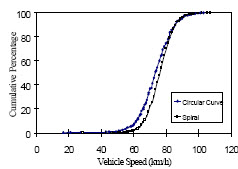
So the 85th percentile rule is simply a recognition that speed limits are set for the purposes of enforcement. And since law enforcement only has the resources to cite the most egregious violations, the speed limit is established at or near the 85th percentile, making only about 15% of free-flowing motorists violators.
You may also notice that motorists who go a few mph over the speed limit are not cited. That occurs for two reasons. The first is the lack of law enforcement resources. But where the system really falls down is at the judicial level. Traffic court judges routinely give a 10-12 mph leeway on speeding tickets out of a false belief that radar is inaccurate. So even if some motorists do base their speeds on the speed limit, they routinely go about 10 mph over and almost never get a ticket.
There is a way to control speeds. Leonard Evans, a traffic safety specialist, describes it in his book, Traffic Safety, which is available online. He points out that combining automated in-vehicle speed enforcement with a small fine would cause everyone to lower their speeds immediately. He observes that it is not the size of the fine, but the certainty of being caught that influences behavior. Unfortunately, privacy concerns have prevented serious consideration of such a system. I am fond of asking, though, “What does privacy have to do with driving an automobile?” After all, driving a car is supposed to be a privilege, not a right.
Another thing: Over the years, I have gotten to know many policemen in my career as a city traffic engineer. One of the things they tell me is that the worst speed violators tend to be the politicians. So it is unlikely that the politicians would ever approve a system that would force them to slow down.
So, if speed limits don’t really control speeds, is there a way to keep speeds down? Perhaps the best way to implement in-vehicle speed enforcement systems is to start with motorists who drive for a living and are regulated by law enforcement anyway, such as truck or taxi drivers. Once that is proven practical and effective, then perhaps the system could be expanded to drivers convicted of DUI, then teenagers, and eventually every motorist on the road.
Per CVC 22348(a), any person who “drives a vehicle upon a highway” is required to obey the maximum speed limit. Per 21200(a), cyclists are included among those drivers who are subject to this provision, unless someone argues that the maximum speed limit is one “which by its very nature can have no application” to cyclists.
If cyclists are subject to that provision, are cyclists’ travel speeds required to be counted in the “engineering and traffic survey” required to set that 85th percentile level?
Are there enough cyclists in the traffic mix to make a statistically significant difference in the speed distribution observed during such a survey?
Pingback: Commonwealth Conversations: Transportation: MassDOT State Traffic … | Traffic Engineering Addict
Pingback: Traffic Engineer Tatum earns employee of month for January … | Traffic Engineering Addict
=v= Informative as this blog entry might be, it does not address the dynamic underlying our nation of chronic speeders. After WWII it became standard practice to overbuild roads, under the premise that this would add a margin of safety. As we have learned for the last half-century, though, what it really does is encourage motorists to speed.
I don’t know why most motorists drive so recklessly fast. But truckdrivers are put under great pressure to deliver their cargo as quickly as possible, which is more quickly then reasonable. They are often heavily penalized for delays, either directly or indirectly. It is a case of unbalanced feedback. They get very little feedback about speeding but a lot of feedback about delay.